

By Kellye Y. Testy
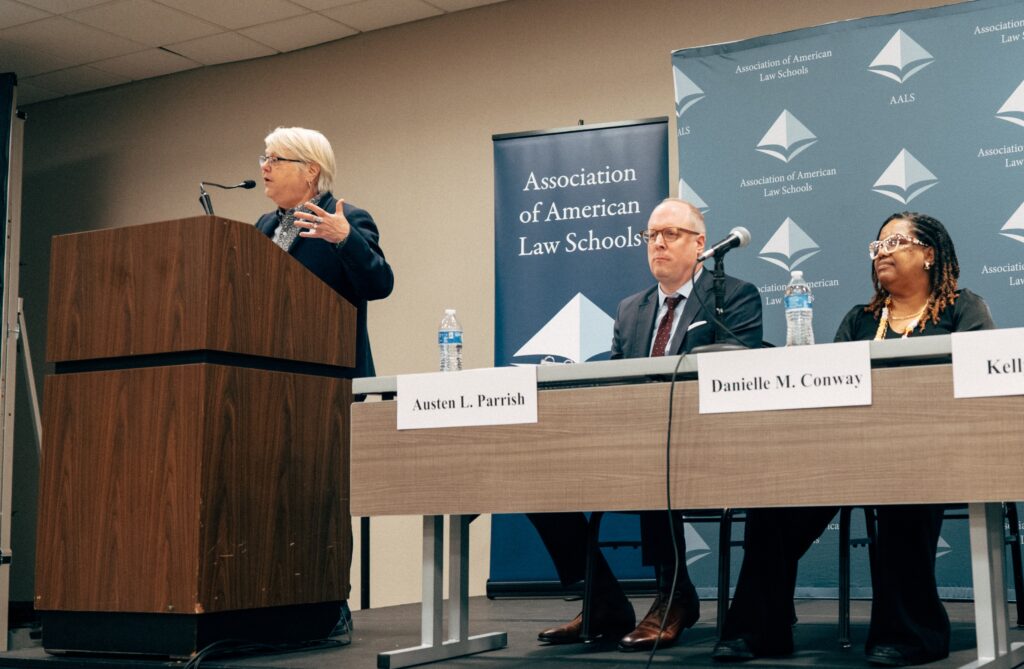
Delivered on January 9, 2026 at the AALS Annual Meeting in New Orleans.
Dear Colleagues,
Welcome to the 2026 Annual Meeting. It is difficult to overstate how active and consequential the past year has been for legal education and for the Association of American Law Schools. This moment also coincides with a period of reflection and celebration, as we mark the 125th anniversary of the Association. That history reminds us that the legal academy has faced profound challenges across many eras, and that our greatest strength has always been our ability to remain connected, engaged, and committed to one another and to the rule of law.

I begin by expressing deep gratitude to the many individuals who make the work of the Association possible. Hundreds of volunteers, section leaders, and committee members contribute their time and expertise to advance our mission, supported by a small but extraordinarily dedicated staff. This year also marks the retirement of two pillars of the Association’s dedicated team. Tracie Thomas, who has planned AALS meetings for decades, concludes her remarkable service with this Annual Meeting, and Mary Cullen, also retiring this year, has played a central role in ensuring strong succession and continuity. Their contributions exemplify the spirit of service that sustains this organization.
The mission of AALS is to uphold and enhance excellence in legal education, guided by our core values. Today, the Association includes 174 member law schools and 19 fee-paid schools. As the learned society for legal education, AALS exists to serve faculty, deans, administrators, and staff across our member institutions. In that sense, the Association is not separate from its members; it is a hub that reflects and amplifies the collective work of the legal academy. Although our staff is small—approximately twenty-five people—the Association functions as an extension of your schools, supporting you in ways that are both visible and, at times, deliberately behind the scenes.
Over the past year, AALS developed a strategic plan to guide our work through 2028. This plan reflects our commitment to meeting the increasingly complex needs of law schools and to providing critical services across all stages of academic and professional careers. Central to this work is the creation of opportunities for faculty and deans to connect with peers beyond their own institutions. These connections foster collaboration in scholarship, teaching, and leadership, and they are particularly vital at a time when the legal academy faces heightened external pressures and internal demands.
AALS convened a wide range of meetings and programs over the past year, both in person and virtually. The Annual Meeting itself brought together more than 2,300 attendees, guests, and exhibitors. In April 2025, more than 800 legal educators participated in the Conference on Clinical Legal Education in Baltimore, a gathering that encouraged reflection on the societal role of lawyers and the responsibilities of clinical teachers. The Association also welcomed new faculty members to the Workshop for New Law School Teachers in Washington, DC, where experienced professors shared practical guidance on teaching, scholarship, and academic service. Additional programs included leadership gatherings for deans, virtual workshops for adjunct and emeritus faculty, and section-sponsored programs addressing topics such as health and wellness, artificial intelligence, community building, the rule of law, and navigating difficult conversations in polarized times.
Professional development and support for law school deans remained a central priority. AALS continued its formal mentoring program connecting newer deans with experienced and retired leaders, offered regular virtual networking opportunities, and sustained the Deans Dialogues webinar series, now in its seventh year. In partnership with the ABA Section of Legal Education, the Association presented several leadership-focused programs, including the New Deans Workshop and the Law School Development Conference. AALS also maintained clearinghouses addressing academic freedom, antiracism, student mental health, and the rule of law, ensuring that deans have access to shared knowledge and resources during challenging times.
Faculty recruitment services expanded in response to member feedback and a strong hiring market. More than 400 candidates and 160 schools participated in AALS hiring initiatives during 2025. The Association introduced a virtual faculty hiring platform to streamline screening interviews and hosted regional recruitment events across the country. Complementary webinars supported appointments committees and candidates, including programming tailored to international applicants and aspiring legal academics.
The Association also advanced its role as a producer and curator of research, publications, and information. AALS released a study examining the experiences of women attorneys in higher education leadership and continued to support the Journal of Legal Education, which published four issues, underwent a redesign, and expanded access to its historical archives. In April, AALS launched AALS LENS: Legal Education News & Stories, a multimedia platform highlighting developments across the legal academy. The acquisition of the Rosenblatt’s Deans Database and stewardship of the TaxProf Blog further strengthened the Association’s capacity to support scholarly communities and provide timely information.
In addition to these programmatic efforts, AALS has expanded consulting and advisory services for law school leaders, offering mentoring, coaching, and strategic planning support. Former AALS Presidents and deans now serve as Distinguished Counselors, bringing decades of experience to schools navigating complex institutional challenges.
A significant portion of the Association’s work this year has taken place at the national level. As legal education’s representative to the Washington Higher Education Secretariat, AALS has engaged extensively with peer organizations and government actors on issues affecting higher education, including accreditation, student loans, research funding, diversity and inclusion initiatives, and access to justice. The Association has also participated in conversations with courts, bar leaders, and regulatory bodies regarding accreditation, innovation in legal education, and pathways to licensure. While some of this advocacy work is necessarily quiet and collaborative, it reflects a sustained commitment to protecting the integrity of legal education and the rule of law.
At the same time, AALS has increased its direct support to individual schools facing mounting pressures. Deans, faculty, and staff are navigating unprecedented demands, and the Association has worked to respond quickly with resources, guidance, and, when needed, hands-on assistance. This support underscores our dual mission as both a learned society for faculty and a membership organization for law schools as institutions.
It has been an honor and a privilege to serve as Executive Director and CEO during this period of growth and challenge. I am continually inspired by the work taking place in classrooms, clinics, and communities across our member schools, and by the generosity of those who volunteer their time for the collective good of legal education. As we look ahead to 2026 and beyond, I am confident that by remaining engaged, inclusive, and committed to our shared values, we will continue to advance excellence in legal education together.
Thank you for your dedication to legal education, this Association, and the future of law and justice.