

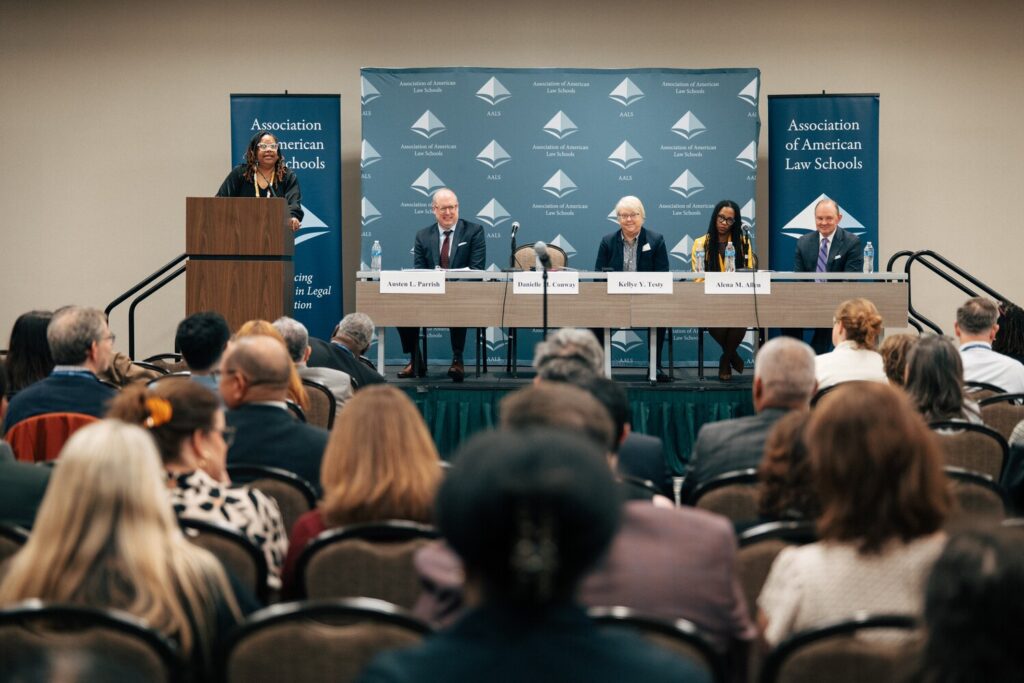
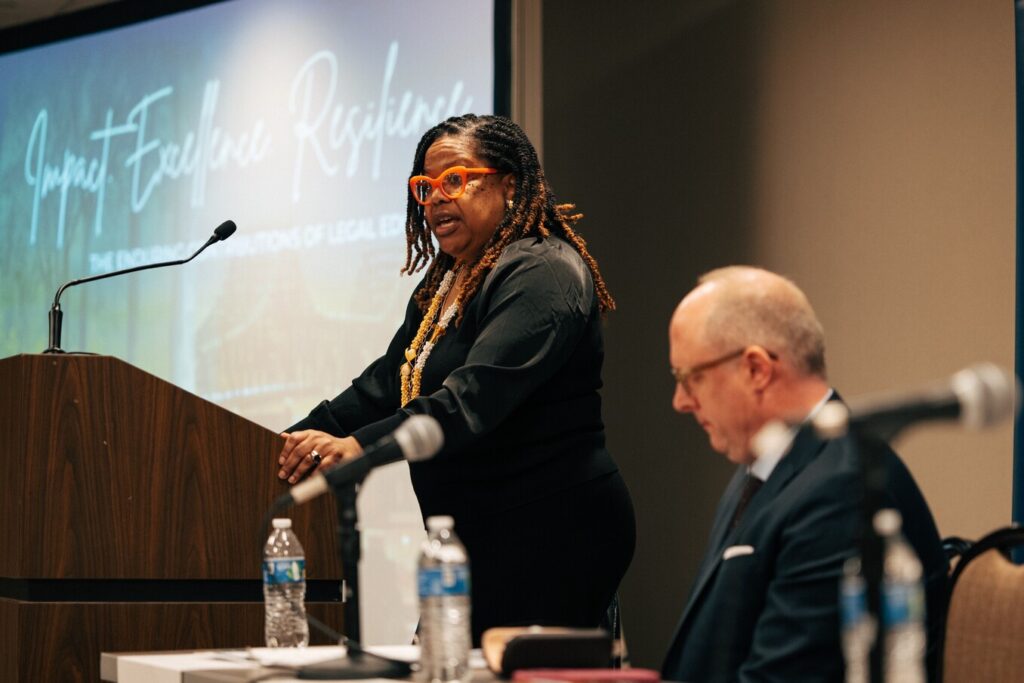
Presidential Address – Meeting of the AALS House of Representatives at the AALS Annual Meeting in New Orleans, LA on January 9, 2026
By Danielle M. Conway, AALS President
Dean and Donald J. Farage Professor of Law, Penn State Dickinson Law and School of International Affairs
Introduction:[1]
I have long set my sights on becoming President of the Association of American Law Schools (AALS). What was it that spoke to me about this organization and its stakeholders? No doubt, it was the degree of intellectualism, the weightiness of formal and informal conversations, and the unexpected, yet crucial relationships with colleagues that grew deeper and more meaningful with every meeting. But in my first encounters with the AALS, I was clearly at the fringe, and this stung.
My position as a legal writing instructor with no status, no security, and little respect all but ensured my invisibility. Well-meaning, and sometimes not so well-meaning, commentators questioned my scholarly agenda and, at times, discounted its relevance and significance. Thus began my considerations about access and entitlement to academic freedom. Even after attaining some status, my access to academic freedom was tested by my positionality, intersectional identity, and research agenda. These reference points illuminate the precarity of access to academic freedom experienced by outgroup members throughout higher education. Who knows better than outgroup members about the threats to knowledge workers, threats now faced by all of us in the current political economy?[2]
Thus, as knowledge workers, we must meet these threats by rethinking “structures, practices, and culture.” For critical reference, I use “knowledge work and worker,” on its own or interchangeably with the designation academic as a more inclusive term to cover the work, creation, and diffusion of all contributors to the store of knowledge. I believe a principle upon which we can agree is that academic freedom is oxygen for knowledge work and workers. I center knowledge workers as beneficiaries of academic freedom for several reasons. First, most knowledge workers recognize that intellectual inquiry is vital, regardless of whether access and entitlement are equally distributed. Second, academic freedom is a non-rivalrous resource, meaning one’s access to it does not extinguish another’s access. Third, academic freedom complements and supports the right of freedom of expression in the greater public sphere.
Academic freedom is at its zenith when it is untethered from exclusivity, elitism, and hierarchy. If there is one thing that should be promoted holistically and democratically, it is an ameliorative understanding of academic freedom, and how that understanding supports teaching and learning communities that value inquiry with integrity, debate with dignity, and discourse with accountability.
Through the lens of academic freedom, we can analyze the impact of the coordinated actions of government officials and pundits challenging democratic governance and the rule of law. Today, too many institutions charged with upholding democratic ideals capitulate to actors committed to eroding democratic norms. Now, more than ever, universities and law schools must retake their place as leaders of intellectual inquiry. Through narrative, storytelling, and dissection of oppressive governance, methodologies, and pedagogies, we must reembrace our role as convenors of American democratic experimentation.
Our collective superpower in the legal academy is the command of facts, nuance, context, analysis, persuasion, and advocacy. We are the best resource to explain the reach and contours of academic freedom and to be its defenders. How? First, we must convey what it is and what it is not. Second, we must define its purpose. Finally, we must protect knowledge workers in its exercise.
Dean Emeritus Robert Post explains that in higher education, “there is freedom to discover, develop, and distribute ideas in pursuit of knowledge and diffuse it in education.” Post notes further that “[i]n the public sphere, there is freedom to debate and deliberate about ideas in expressing and responding to others’ opinions.”[3] The purpose of academic freedom is the protection of education and knowledge advancement, while the purpose of freedom of expression is the safeguarding of self-government. Each principle comes with its own set of constraints. Notably, the constraints for academic freedom include being accurate, exercising restraint, and showing respect for the learned or researched opinions of others. The constraints on freedom of expression—distinct categories of unprotected speech—are narrower.[4]
Academic freedom is the power to explore controversial and unpopular topics without fear of retribution. The aim is to foster an environment in which critical thinking, differing perspectives, and intellectual discovery go beyond one’s own subjective truth. Thus, in the classroom, in extracurricular programming, in operations, and in administrative decision-making, we must demonstrate by sound and considered processes how to navigate context, conflict, and controversy in ways that promote trust, education, knowledge advancement, and accountability. We must convey how academic freedom in higher education supports the fundamental right of freedom of expression in American society writ large. We must show the straight line and short distance between government curtailment of academic freedom and government censorship of one’s thoughts, ideas, and beliefs. Accordingly, my charge is to Emancipate. Academic. Freedom.

Emancipate:
The assault on higher education is driven by high stakes battles to determine who will educate the next generation of leaders, thinkers, and doers and how they will be educated.[5] Emancipate academic freedom calls on a coalition to stand together to contest unwarranted attacks on knowledge work.
Emancipation, in the context of legal education, is meant as an entreaty to consider reconstructing academic freedom. Emancipation signals that the history of academic freedom was not so free nor accessible to all. Confronting that history is an ongoing critical exercise to acknowledge and address obstacles to participation in knowledge work.
I draw on the historical origins of formal legal education from Reconstruction to the first half of the 20th Century to illustrate the need to emancipate academic freedom. During this period the exercise of elitism and exclusion of outgroups from law schools limited who could participate in the project of discovery and discourse. For example, legal education was bereft of racialized, gendered, intersectional voices during a significant part of its existence. The Civil Rights Movement in the 60s, the second wave Feminist Movement in the 70s, and the Critical Race Theory Movement in the 80s saw outgroup members insisting on being recognized for their experiences, not for themselves, but for the benefit of a profession that praised itself for extolling the virtues of equality and justice.
Emancipation seeks to uncover real academic freedom, meaning that all learned ideas are subjected to the same processes of rigorous examination. None get a pass based on the pedigree of their proponents, and none are excluded on that basis either. The purpose of academic freedom is the truth-seeking enterprise, and the way we get closer to truth is holding each other accountable, through critical, empirically informed engagement with each other’s claims. The obligation to be accountable is a special duty imposed on the knowledge worker, counseling against dogmatic adherence to the opinion free-for-all. Instead, the special duty demands accuracy, the exercise of restraint, the show of genuine respect for learned opinions, and the pronouncement of clear disclaimers.
Emancipating academic freedom is especially consequential to teaching and learning communities. An opinion free-for-all, while offering certain pedagogical benefits, has no favor when such opinions are neither evaluated nor verified. This approach gets more pernicious if such opinions perpetuate hierarchy, elitism, and exclusion. A classroom that nurtures academic freedom through inclusiveness, integrity, respect, and dignity can provide an environment that does not settle on a particular answer but solicits questions that lead to the uncovering of new and suppressed knowledge. This is the concept of accountability that features prominently in the American Association of University Professors’ (AAUP’s) definition of academic freedom. Accountability guards against ideological framings that promote intractable divisiveness, undermine intellectual inquiry, and harm the communal learning environment. Emancipate, as the first pillar of the theme, urges liberatory action to contest threats to academic freedom and leads to pillar two, academic.
Academic:
Knowledge workers in the academy are inviting targets from both inside and outside of higher education. Brian Rosenburg, former President of Macalester College, points out that “attacking colleges is a relatively low-risk, high-reward” strategy to activate highly polarized political bases. I add that attacking knowledge workers is just as potent when the purpose is to suppress and chill education and knowledge advancement through the exercise of preferencing academic freedom for some and not others. This selectivity about who can exercise academic freedom incriminates the origins of the legal academy and the complicity of law in perpetuating interlocking systems of oppression.
Exclusion and selectivity in legal education as well as the structure of higher education itself historically and in the neoliberal era have determined “Who benefits and how they benefit from the status of being an academic?” At the launch of formal legal education in the United States, academics were overwhelmingly white men, who benefitted from the exclusion and selectivity in matriculation at law schools. Known as the pipeline effect, the process of exclusion and selectivity explains the overrepresentation of white men in the law professoriate, driven by a self-reinforcing system designed to limit diversity at all levels of the legal enterprise.
The pipeline effect, and its embedding of racism and oppression, reinforces inequality in speech and intellectual inquiry by conceiving too narrowly who counts as an academic. This narrow conception silences and erases those not viewed as academics. This outgroup invariably includes students, staff, and administrators who cannot easily access the protection of academic freedom, reifying historical systems of exclusivity and selectivity into current structures.
The assault on higher education is ensnaring more knowledge workers than we care to admit. Even those who remain eligible to claim the status of an academic are themselves faced with censure and the undermining of their knowledge work. These impediments to teaching and learning mean that even privileged roles in higher education remain vulnerable to political machinations. These acts then determine what teaching and learning are, and who will or will not receive the protection of academic freedom.[6]
At least two considerations underscore this vulnerability. First, protection and security of position are myths in an increasingly authoritarian regime. Second, the growing complexities of higher education and political incursions upon it impair the education enterprise.[7]
Reconceiving who is a knowledge worker provides a dynamic perspective on access and opportunity for the exercise of academic freedom. A more expansive view of who is a contributor to knowledge work will transform and strengthen a new coalition capable of defending academic freedom. Secondary effects of such a coalition include dismantling hierarchies and disrupting invisible systems that strangle progress. The goal should be expanding the tent while simultaneously buttressing academic freedom.[8]
Illustrating this approach is ABA standard 208, “Academic Freedom and Freedom of Expression.”[9] When reading and interpreting the standard, it is critical to acknowledge its inclusive reach. The reality is that more people outside of the tenured/tenure-track ranks are instructing students in response to internal and external pressures. As a result, we must consider that academic freedom should extend broadly to protect the acts of intellectual inquiry, critical pedagogy, and reasoned discourse. Building solidarity strengthens holistic and democratic engagement by extending academic freedom to all knowledge workers. Liberation from a narrow conception of the academic is an important act to emancipate knowledge workers in the legal academy. This leads to pillar three, freedom.
Freedom:
Freedom in the United States labors under the yoke of systemic inequality, past and present. Freedom is a social construct dependent on the existence of justice and equality, and it hinges on the mutual responsibility for all to be accountable. Accountability is a key feature of academic freedom. To be accountable means to acknowledge the existence of facts, data, and knowledge, to answer for their misuse, and to correct mistakes. To be accountable also means to act with integrity and transparency for intended and unintended consequences, outcomes, and impacts.
While colleges and universities have their challenges, they remain some of the best institutions for teaching and learning freedom praxis. Instrumentally, education and knowledge work occurring in our educational spaces ripple out into our workspaces, play spaces, and private spaces, creating muscle memory for holistic and democratic action and accountability. Absent this accountability, the third pillar—freedom—is nothing short of fantasy.
Actionable freedom requires consistent commitment to being accountable to others. Accountability requires engaging deeply with facts and data and critically examining our subjective understandings of the knowledge we create or unearth as well as that of others. It counsels exposing our learned ideas and interpretations to the scrutiny of others who should exercise the freedom to critique our research agenda, analyses, and conclusions, but who, themselves, adhere to the obligation to engage in reasoned and dignified dialogue and discourse. As well, freedom comes with commensurate obligations to disrupt hierarchies that potentially skew and distort education and knowledge creation. Accordingly, without accountability, freedom is unrealizable.
Conclusion:
The theme —Emancipate. Academic. Freedom. — focuses the lens on higher education and law schools as sites of connection for education, intellectual inquiry, and knowledge advancement. It encourages deep thinking about the responsibilities of law schools to uphold democratic ideals, to resist pre-compliance, and to contest actions by those who would parlay power through political polarization, ideological censorship, and state interference.
As we plan our programs and events for the 2027 AALS Meeting in New York City, Let’s frame and defend academic freedom for the public good. Let’s go on offense by explaining the purpose of academic freedom and its importance in defending foundational democratic principles. Let’s rebuild hope and trust through a coalition transforming our law schools into radically equal and just spaces for those depending on us and following us in this work. We are ready for this moment to both protect academic freedom and to transform it.[10]
[1] I thank the following commentators for adding coherence and balance to this speech: Dean Richard Moberly; Associate Clinical Professor Bethany Schols; Program Manager TaWanda Hunter Stallworth; Professor Jud Mathews; AALS Executive Committee Members—CEO & ED Kellye Y. Testy, Dean Austen L. Parrish, Dean Melanie D. Wilson, Dean Anthony W. Crowell, Dean Renée Hutchins Laurent, Professor Risa Goluboff, Professor John Valery White, Dean Leonard M. Baynes, and Dean Stacy Leeds; and Penn State Dickinson Law Dean’s Fellows—Abigail Knotts, Lauren Nicole Mazzatesta, Cassandra Schmidt, Elizabeth Knapp, Alessandra Ayoub, Tristen Sutton, Courtney Carmichael, Dante Coppotelli, Sarah Joan Hamer; and Emily Ankiewicz. Finally, I thank my steadfast, loyal, and efficient research assistants, George Alemya Ayine, ’26 and Shanell Powell, ’27, for their skills with verification of sources and citations.
[2] Brian Rosenberg, Whatever It Is, I’m Against It: Resistance to Change in Higher Education 24 (Harvard Educ. Press 2023).
[3] Lincoln Caplan, Academic Freedom and Free Speech, Harv. Mag., Sept.–Oct. 2024, https://www.harvardmagazine.com/2024/09/harvard-academic-freedom-free-speech.
[4] In the context of freedom of expression, the constraints that rise to the level unprotected speech include fighting words, true threats, incitement to imminent lawless action, obscenity and child pornography, and defamation.
[5] See Rosenberg, supra note 2, at 58.
[6] Angela Onwuachi-Willig, Introduction to the Boston University Law Review Symposium: The University and Democracy (Nov. 14, 2025) (notes on file with author).
[7] The complexity owes to both internal processes and external forces that include shrinking budgets, low and spiraling enrollments, the rising cost of education, society’s distrust of higher education, tribalism, and rampant misinformation.
[8] G.S. Hans, Clinical Academic Freedom: Old Threats, New Protections, ___ Wash. U. J. L. & Pol’y___ (forthcoming 2026), https://papers.ssrn.com/sol3/papers.cfm?abstract_id=5650771.
[9] ABA Section of Legal Educ. & Admissions to the Bar, Standard 208: Academic Freedom and Freedom of Expression (2024).
[10] Some notable examples of the coverage of academic freedom, inclusive of accountability, in the teaching in learning enterprise follow:
Students: in the classroom, bringing in relevant current events and policies—say Trump Eos—even if controversial or offensive, but then pursuing accountability and best pedagogical practices to meter discourse.
Staff: extending academic freedom to, for example, career services professionals who produce programming involving employers and then considering the appropriate content of that programming.
Faculty: defending academic freedom of knowledge workers to teach about systemic racial equity, unitary executive theory, Critical Race Theory, reproductive justice, abortion rights, states’ rights, the full spectrum of immigration issues, clinic representation on issues like climate change, and free trade and free market systems.
Administrators: protecting deans and associate deans who support academic freedom of students, staff, and faculty but also who engage with producing programming about accountability, for example, establishing review processes for when academic freedom is misused.