

Katie Kempner, Director of Research & Data Analytics
In August, AALS partnered with the American Council on Education (ACE) and several other higher education associations1 to distribute a brief survey to law school deans about how graduate and professional education leaders, their institutions, and their students are responding to changes resulting from the One Big Beautiful Bill Act (OBBB).
While OBBB brought several changes, including revised definitions of professional degrees, the biggest question law schools are facing in this first year of its implementation is what impact the elimination of Grad PLUS loans and new borrowing limits for graduate and professional students will have on current and prospective law students.
Survey results from law school deans, associate deans, financial aid directors and other administrators2 provide a first look at the answers to some of these challenging questions.
Law School Responses to OBBB Borrowing Limits
The most commonly cited response to OBBB borrowing limits was establishing new partnerships with private lenders or alternative financing providers (38.6% of respondents). About a fifth of respondents reported that their school is providing new or increased institutional grant, scholarship, or other non-loan financial aid to students (22.7%). The same proportion reported that their school is either still deciding what changes to make (22.7%) or that their school is not making changes in response to these provisions (22.7%).
Law School Responses to New OBBB Borrowing Limits
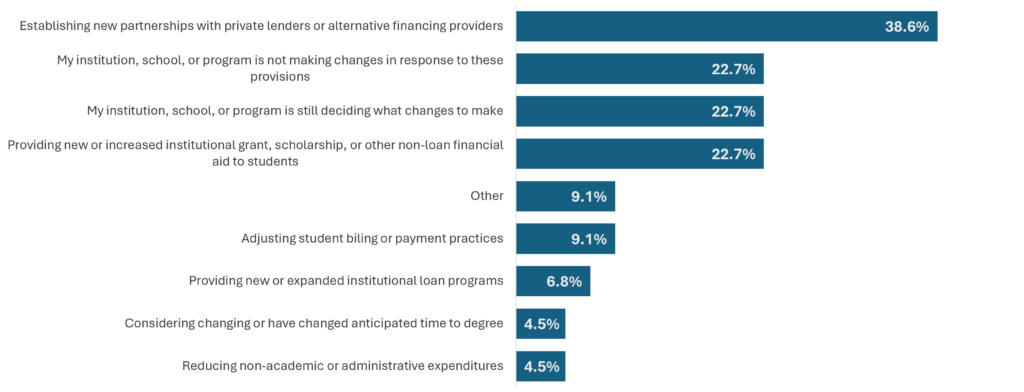
Q: Given the new borrowing limits under OBBB, how is your institution, school, or program responding to these changes? Select all that apply. (n=44)
Of respondents who reported that their school is establishing new partnerships with private lenders or alternative financing providers, the most commonly cited specific action was referring students to a preferred private lender list or marketplace (76%).
Reported Changes in Applicants and Accepted Offers of Admission
In this first year of OBBB implementation, and amid steady increases in law school applications3, most respondents reported that their school had significantly more applicants than the prior year (60% of respondents). Respondents who reported any change in applicants – increases or decreases – were asked to what degree they attribute these changes to the new borrowing limits. The majority (66.7%) of respondents who reported any change in applicants reported that these changes are not attributable to the new OBBB regulations. While law schools are somewhat unique among the graduate and professional programs invited to participate in the survey in terms of seeing increases in applications, most respondents from other fields also reported that any applicant volume shifts they observed this year are either only somewhat attributable to the OBBB changes, or are not attributable to the OBBB changes.
Responses about changes in accepted offers of admissions were more mixed – about a third (28.9%) reported their school had significantly more acceptances than the prior year; close to a fifth (22.2%) reported their school had slightly more acceptances; and a third (33.3%) reported having as many acceptances as the prior year. A small proportion (13.3%) of law school respondents reported their school had slightly fewer acceptances than the prior year. Again, a plurality (40%) of law school administrators who said their school did see shifts in the number of accepted offers of admission reported that these shifts were not attributable to the changes brought on by OBBB.
Broadly speaking, the survey results suggest that the connection between the financial aid changes implemented when OBBB went into effect this year and any recent change in law school applicant numbers is not yet clear. It is also not yet clear how this new financial aid landscape may impact admitted students’ decisions about where to go to law school, or perhaps whether to go at all.
Observed Student Responses to OBBB Changes
Survey respondents were asked to assess how current students are responding to the changes implemented by OBBB. Two things stand out in the survey results: students are demonstrating more concern for their financial status than usual, and seeking alternative financing options, such as private student loans. Sixty percent of law school survey respondents reported their students are responding to the OBBB changes in these ways. A small proportion (14%) of respondents reported that students are dropping out or stopping out of the school or program; the same proportion (14%) reported being unsure of student responses because it is too early to tell.
Observed Student Responses to New OBBB Borrowing Limits
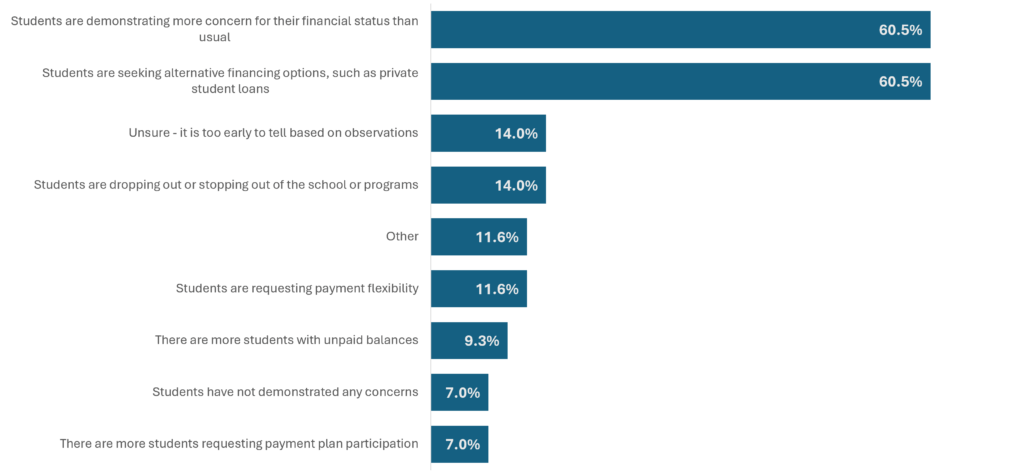
Q: Given the new loan borrowing limits, how are current students in your institution, school, or program responding to these changes? Select all that apply. (n=43)
Information Needs
When asked about needs for more information, just over half (53.5%) of law school administrator respondents indicated that benchmarking on how peer institutions are responding would be useful. A smaller but significant proportion (41.2%) of respondents need information on private lender and alternative financing partnership options.
Law School Leaders’ Information Needs Around Implementation of OBBB Changes
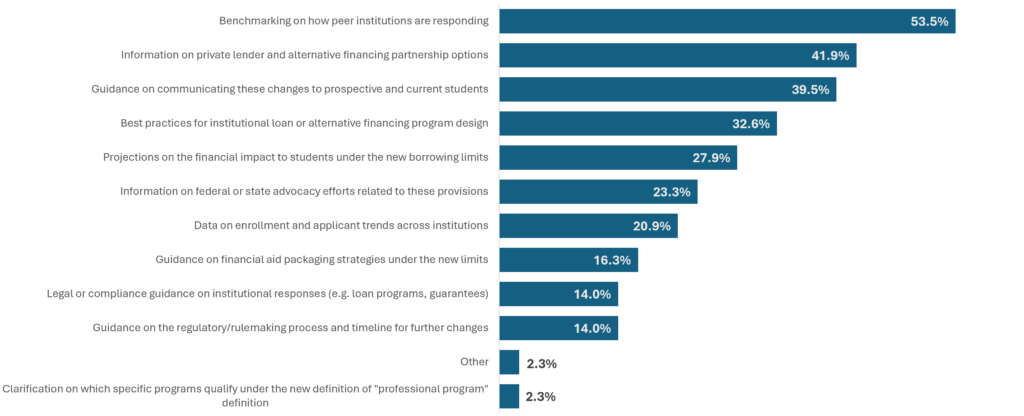
Q: As your institution, school, or program navigates changes to borrowing limits as a result of implementation of OBBB, what additional information would be useful? Select up to three (3).
As the impacts of OBBB changes on current and prospective law students become clearer over the next months and years, AALS will continue to monitor law school leaders’ reactions and what best practices are emerging, and to keep law school leaders and administrators informed.
ACE’s reporting on the overall survey results, including those from other associations, is available here.
Endnotes
- The American Association of Colleges of Nursing (AACN), the Association of American Medical Colleges (AAMC), the Council of Graduate Schools (CGS), and the National Association of College and University Business Officers (NACUBO) also participated in this community survey project. ↩︎
- 45 law school deans or other administrators responded to the survey via a link they received directly from the AALS research team via email. 66% of respondents were Deans; 13.7% were Assistant or Associate Deans; 11.4% were Financial Aid Officers; 6.8% Executive Director/Directors; and 2.3% Chiefs of Staff. All respondents reported being somewhat or very familiar with the changes under OBBB. ↩︎
- Susan Krinsky, “Early 2027 Data Show Continuing Strong Interest in Law School,” LSAC, October 15, 2026, https://www.lsac.org/blog/early-2027-data-show-continuing-strong-interest-law-school. ↩︎