

As I conclude my year as president of the association, the tradition is for the outgoing president to give brief remarks and reflect on the past year. So, first, I want to extend some thank-yous. It’s been an absolute honor serving as the president during the association’s 125th year anniversary. Thank you. I have to say, when I look at the role or the call of people who have served in the presidency, it’s humbling and it’s an absolute privilege to be among those names. Although I’m most grateful to be sandwiched between two incredible leaders. First, Melanie Wilson, who I had the great fortune to be able to succeed. Melanie right there. Thank you so much.
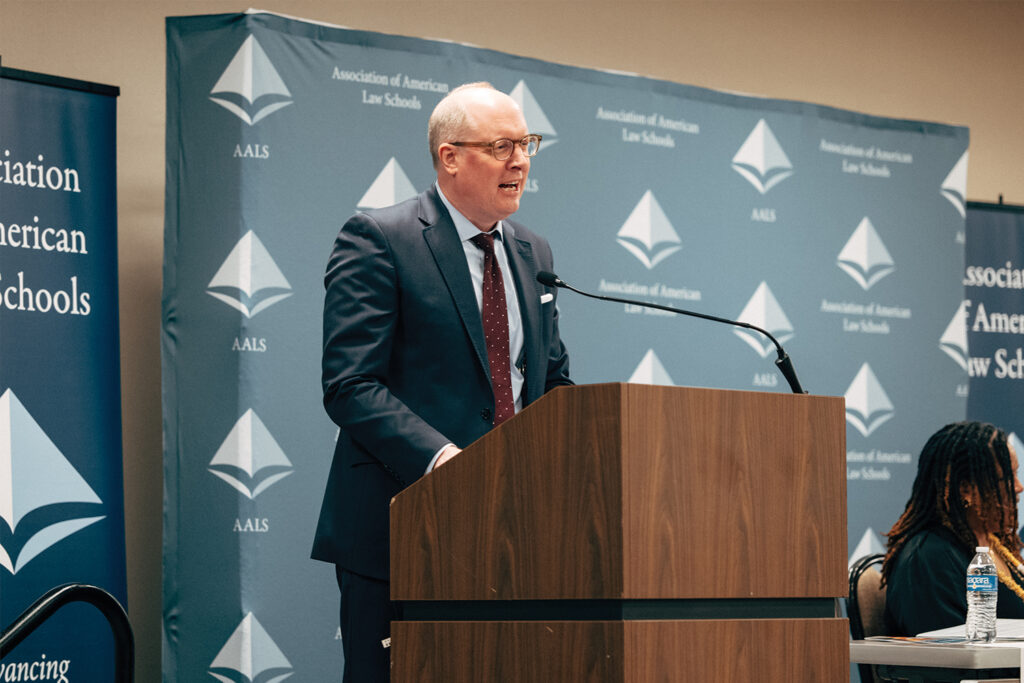
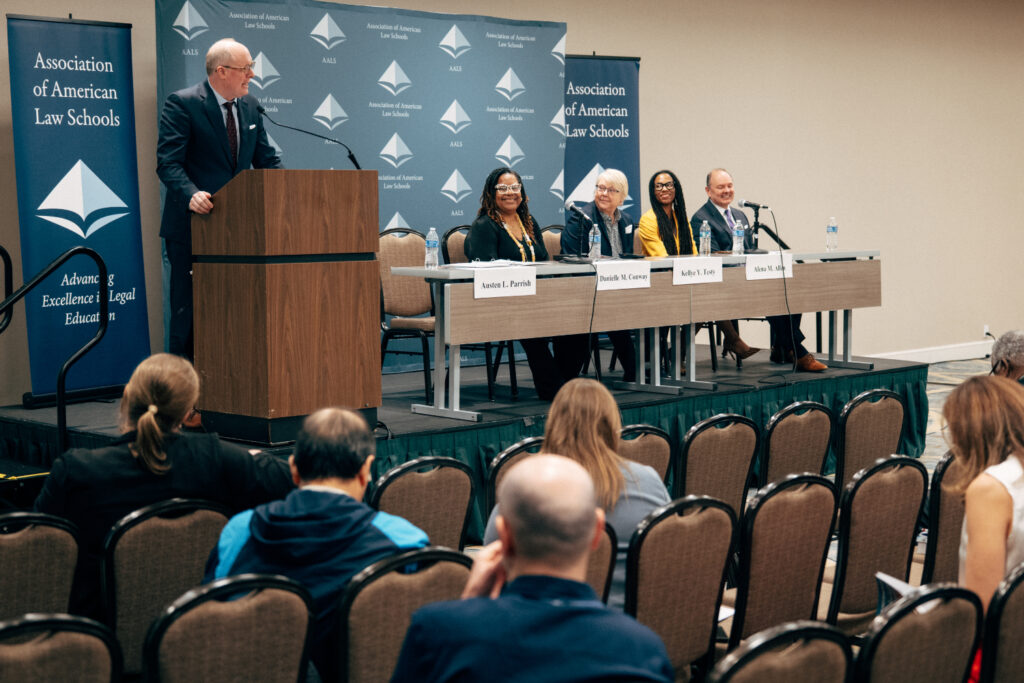
Her meeting theme last year of courage was so present in so many different ways, and then I’m incredibly grateful to be able to pass the baton to Danielle Conway, who’s stepping up in our next president. It is two inspiring leaders and great to be in between them. I’m also grateful to the terrific staff of the association and to our executive director Kellye Testy. I think as you know, the staff worked tirelessly behind the scenes. We owe them a great deal of gratitude. Kellye has provided absolutely steadfast leadership in an incredibly unprecedented year. She’s going to provide more details in her report. And I’m also grateful to the many, many volunteers who’ve served on planning committees, the section leadership that hosted so many quality programs and workshops. But could we pause a moment just to thank the staff of the association, Kellye Testy, and all her work?
When I chose my theme in August 2024, I chose to reflect on the enduring contributions of legal education. Part of that was because I knew we were coming up to the 125th anniversary that occurred in August of this summer. Partly though, it was because of the growing misinformation and misunderstandings about legal education, higher education, and law schools. The political tax on law, the legal profession, and on higher education ended up being unprecedented this past year. And underlying much of those attacks were caricatures about our universities and our law schools and what our faculty, our staff, and our students do. While it’s important, I think, to recognize that we need to continue to improve and innovate, and our quest for excellence needs to continue, it’s also critical to recognize the good that law schools and our colleagues do for our communities and push back on narratives that are false.
This year, we’ve seen legislative and regulatory changes that have attempted to make seismic changes within higher education. Over the past year, there’s currently over 120 investigations opened by the Department of Justice at more than 60 institutions and over 40 states. We’ve seen universities targeted for political reasons, explicitly so. We’ve seen presidents, deans, and other leaders forced to resign, and we’ve seen direct targeting of some of our students. And while much of the headlines have been at the federal level, state governors and state legislatures have also interfered at unprecedented levels in faculty governance and curriculum in ways we have not seen for decades. It’s worth emphasizing a point that came up repeatedly this year in many of the sessions. Resisting steps that weaken legal education or the legal profession is not a partisan or a political issue. The threats of violence to judges and their families, policies making it more difficult, if not impossible for international students to enroll in our institutions, the attempts to unravel national accreditation, the criticism of lawyers doing pro bono work for those most in need, the attacks on efforts to promote access and opportunity, the threats to law firms.
These are concerning for all in legal education and the profession regardless of political perspective and regardless of where you stand on the political spectrum. At a time of hyperpartisanship and politicalization, it is critical to carve a path that makes clear that supporting law schools, the rule of law and the legal system itself are shared values held by both Republicans and Democrats alike. Educators, policymakers, lawyers, business leaders, and others must succeed in reaffirming higher and legal education’s traditional role as a source of innovation, and that we play a critical role in supporting our communities. Part of this year’s meeting and reflecting on our enduring contributions was to hope to highlight some of the good that we do every single day, not just in the classrooms, but outside in the communities we serve. During this year, I’ve been incredibly honored that the executive committee of the AALS, the AALS leadership has done a number of things to support law schools.
Kellye will give more in her report, but that goes from signing onto amicus briefs, to making statements, to sending out AALS LENS announcements, to publishing op-eds, to holding webinars by sections on the rule of law, to mentoring deans behind the scenes who are navigating challenging situations, to creating new resource hubs around the rule law and academic freedom, to engaging with other groups on supporting the legal profession. And then, I am proud that AALS has done that in such a vigorous way. It was also though a very busy year for the more traditional and core work of the associations, which is also so vital to what we do, from webinars to workshops to conferences and other meetings. The association continued to be the place where those interested in becoming new law faculty and those already serving as faculty could come together to convene, to discuss, to brainstorm the pressing issues in areas of research, teaching and service, and to continue to improve the quality of legal education.
So, I want to again by thanking the literally hundreds, if not thousands of volunteers that were involved in the association with a great deal of gratitude to those in the leadership positions, particularly the section chairs and those appointed on the planning committees for all their tremendous work over the past year. It has been absolutely an honor to serve as president this past year. It is one of the highlights of my career. Thank you so much.